Savings.Club · How I work with AI
A design team of AI agents, working under my review
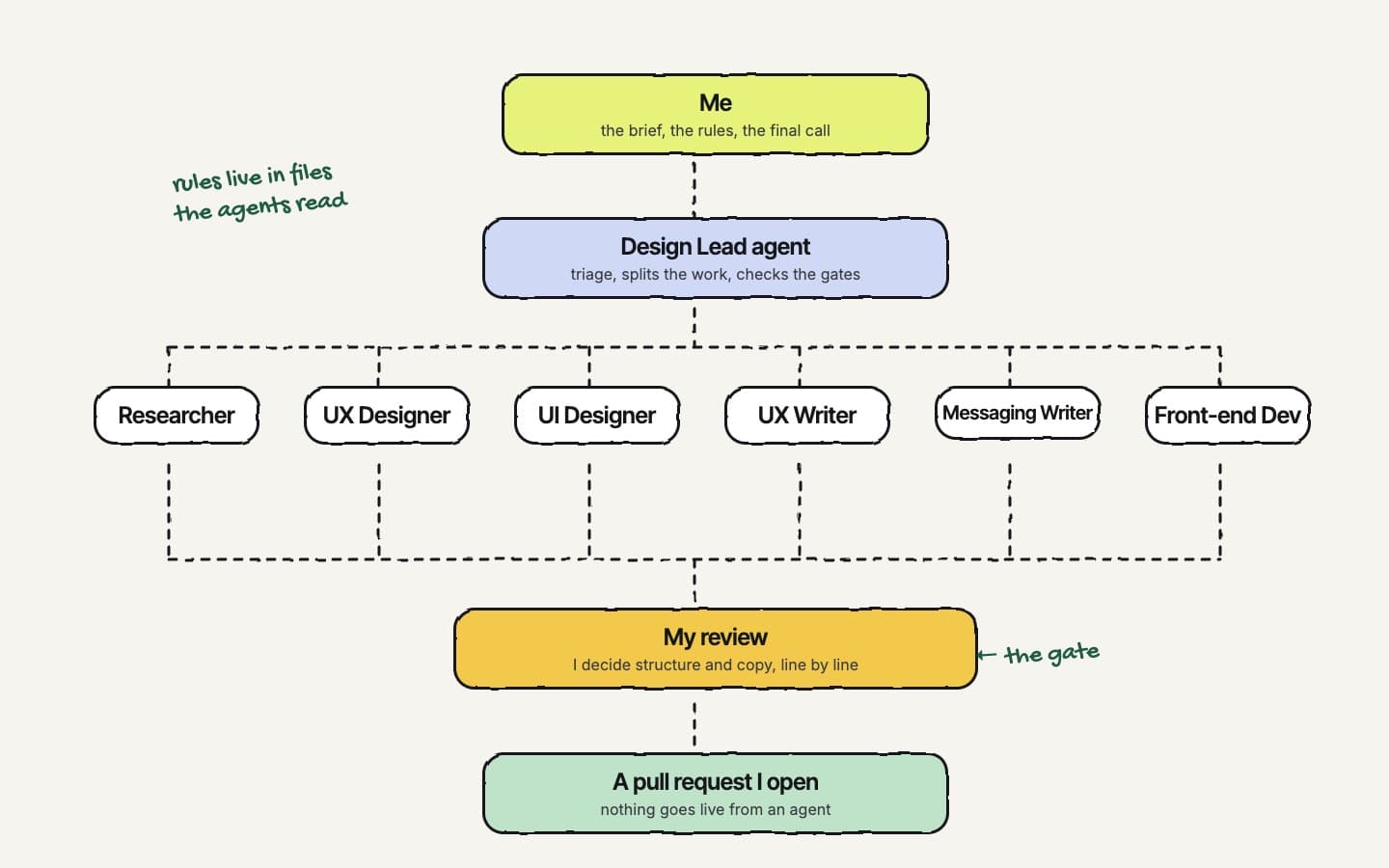
At Savings.Club I lead design across the website, the sign up, the member app and the messages that follow up. To keep that pace without lowering the bar, I built a design team of AI agents. Each agent has one role, the rules live in files they all read, and nothing they make reaches users without passing through me.
How I led it
- I designed the roles, wrote the rules every agent reads and defined the review gate.
- I make every final call on structure and copy, and I open every pull request.
01 · Roles · The team
One role per agent, and a lead that routes the work
A request becomes one card for the team. The Design Lead agent triages it and either hands it to one role or splits it into stages: research, UX, UI, copy, messages and front end. Like on a real team, each role knows what it owns and what it does not.
02 · Rules · Shared rules
Rules written once, read by every agent
What a new teammate learns in their first week lives in files every agent reads: the official terms, the tone of voice, no em dash, numbers only from the source the business owns, and legal consent text that never changes. I change a rule in one place and the whole team follows it.
03 · Review · The gate
Nothing goes live from an agent
The gate is my review. Copy comes to me as a document in page order, and I decide the structure and the words there, not in a chat. Code comes as a branch that I open as a pull request for engineering to review. Messages are scheduled by a person.
04 · First run · What broke
A landing page, from brief to pull request, and what broke on the way
The first real workflow was a landing page in eight stages, from the brief to the pull request. It also showed me where the setup breaks: long runs hit session limits, and the lead does not always wake up when a stage ends. Rerunning the whole job wasted the stages that had worked, so I learned to restart only the stuck stage.
Learnings
- An agent is only as good as the rules it reads. Write them once, in files, not in every prompt.
- Review is the senior part of the job. Agents draft; I decide.
- Plan for the pipeline to break, and know how to restart one stage without redoing the rest.